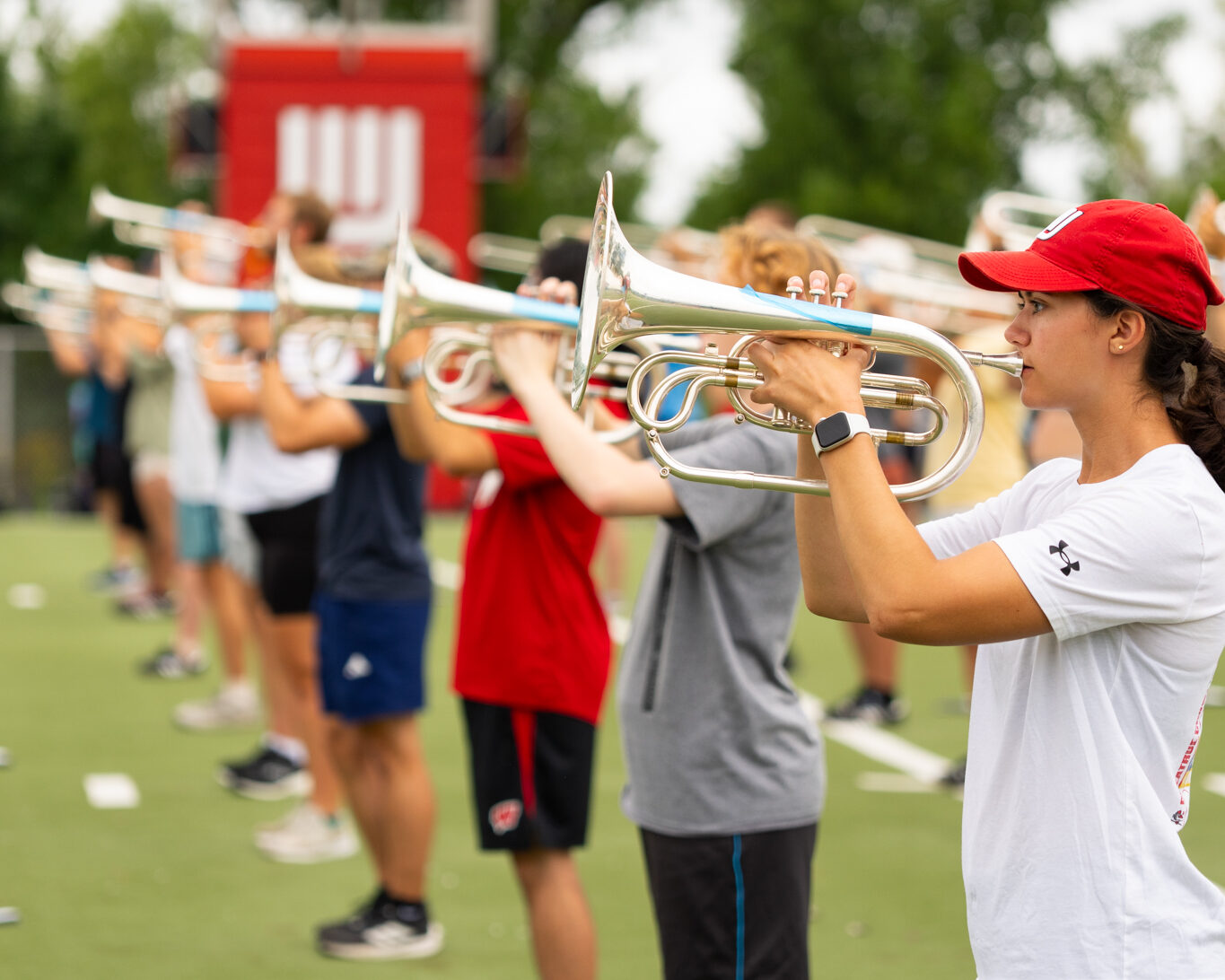
Over 16,000 steps in one afternoon? That’s just a normal Saturday for these young adults.
Meet the feather-plumed-hat toting backbones of the college football field: Big 10 marching band students. They rehearse around 10 hours a week, memorizing music and physically demanding choreography across expansive turf.
“It’s really, really hard,” says Ohio State University (OSU) mellophone player Adeline Harper.
“It is a lot of dedication. You have to be at 110% every single rehearsal, every single performance, every time you’re practicing on your own,” the section leader says.
Left, Right, Left, Repeat
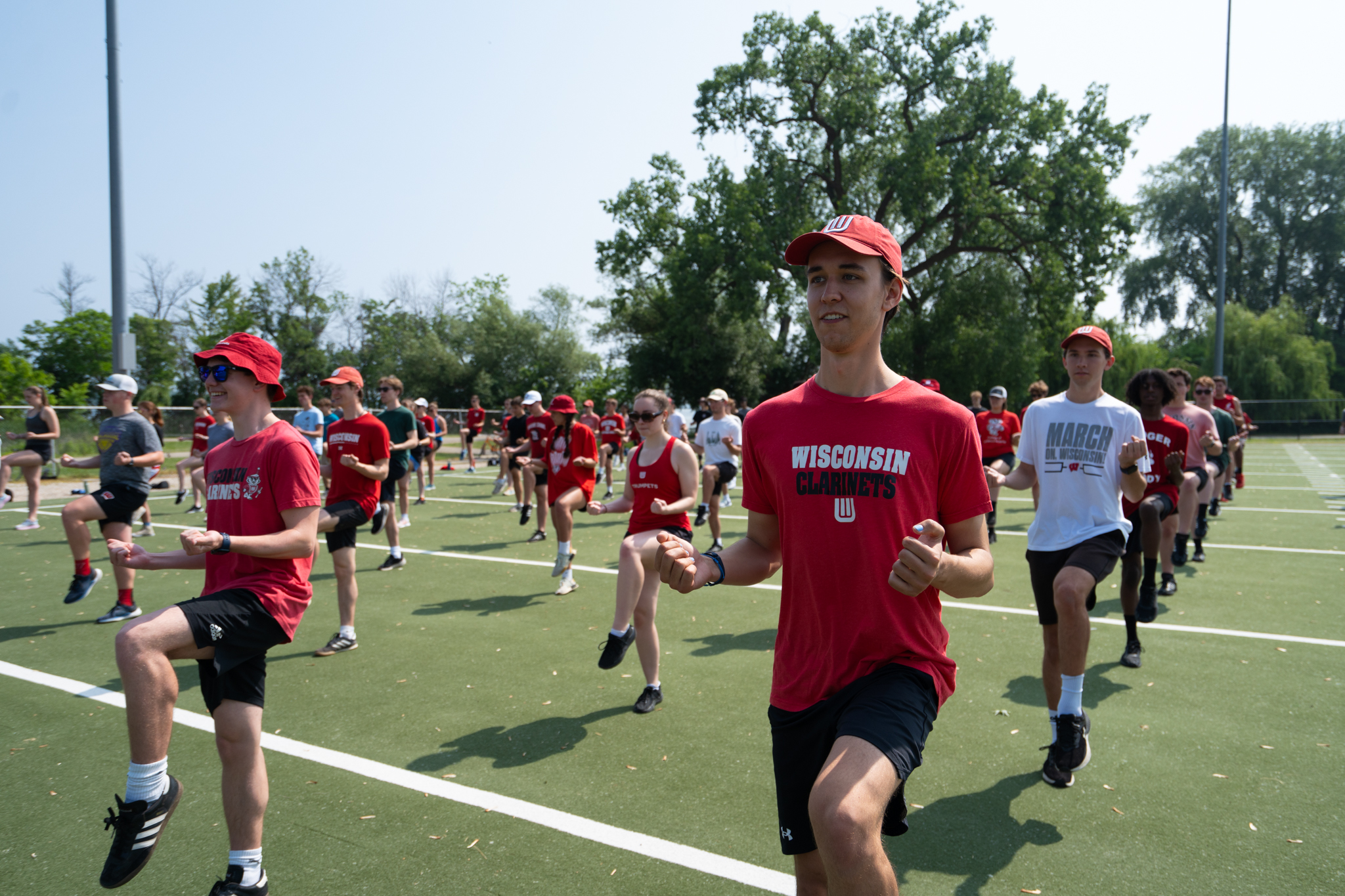
To learn an entire halftime show in as little as five days, Harper’s 200-some bandmates rehearse daily (from 4:10 to 6:15 p.m., and not a minute off). And rehearsals don’t stop after hours.
“I feel like the average member probably spends almost as much time outside of rehearsal memorizing music as they do in rehearsal,” Harper says.
Marchers in “The Best Damn Band in the Land” compete every week for a chance to perform at the game. Some students start practicing together as early as June, and step until the football players have left the field after their last game.
Weeks typically go like this: Music memorization starts on Mondays, followed by section practices by instrument. As the week progresses, the bands put it all together with the marching drill, dictated by an iPad app that tells students where to be on the field, and when. On Fridays and Saturdays, they’ll watch recordings of their rehearsals to fix inconsistencies.
Then, it’s go-time, whether at home or across the country.
“The whistle blows and we’re about to start playing, you hear the crowd just erupt. You just get chills,” says OSU cornet and section leader Bobby Petty. “Just getting to be on that field . . . around the big screens and the whole stadium and confetti going everywhere.”
‘Insanely Cool Tradition’
Big 10 school marching bands have been amping up crowds and bringing art to football games for decades. The University of Wisconsin-Madison’s group has been performing since 1885.
- Est. 1868: Marching Illini | University of Illinois Urbana-Champaign
- Est. 1896: Marching Hundred | Indiana University
- Est. 1881: Hawkeye Marching Band | University of Iowa
- Est. 1896: Michigan Marching Band | University of Michigan
- Est. 1870s: Spartan Marching Band | Michigan State University
- Est. 1892: Pride of Minnesota Marching Band | University of Minnesota Twin Cities
- Est. 1911: Wildcat Marching Band | Northwestern University
- Est. 1878: Ohio State University Marching Band
- Est. 1886: All-American Marching Band | Purdue University
- Est. 1885: University of Wisconsin-Madison Marching Band
“It’s a cherished institution here,” says UW-Madison marching band director Corey Pompey. “And we’re very, very proud of that. It’s comprised of students who . . . [bring] joy to people both on campus and off campus.”
Today’s students continue to carry that joy, on and off the field.


“It’s being a part of something that has almost 150 years of insanely cool tradition,” Harper says. “Being a part of something that’s been really hard and really demanding has completely changed my work ethic. It’s changed the way I view myself.”
“It’s so worth it,” Petty says. “We’re trying to stay serious as we’re marching, but it’s hard to fight back the big smile sometimes hearing my mom or dad in the crowd cheering or that crowd that’s really just there for the marching band.”
While the band director won’t go that far—he’s friends with the football coaches—he does see consistent, overwhelming value for his marchers.
“The university appreciates the band. The state of Wisconsin appreciates the band,” Pompey says. “And when you are performing for people that are appreciative, well, that’s infectious.”